
Key Takeaways
- Market value vs. replacement cost confusion can leave you tens of thousands short when rebuilding after a fire or major storm—your dwelling coverage should match what it costs to rebuild, not what the home would sell for.
- Standard homeowners insurance excludes flood damage entirely, meaning you need a separate flood insurance policy even if you don’t live in a designated flood zone.
- Personal property has strict sub-limits (often just $1,500–$2,500 for jewelry) that can leave high-value items severely underinsured without scheduled endorsements.
- Filing one claim won’t necessarily skyrocket your rates, but multiple small claims within a few years can affect your premiums more than a single large, legitimate loss.
- Maintenance-related damage—mold from neglect, termite damage, worn-out roofs—is almost never covered, making regular upkeep essential to avoid uncovered repair bills.
Believing common home insurance myths can lead to devastating financial surprises. We’re talking about uncovered losses of $20,000, $50,000, or more after a fire, storm, or theft. The phrase “I thought it was covered” doesn’t help when your insurance company denies a claim.
The good news? Most of these coverage gaps can be fixed once you know about them. By reviewing your homeowners insurance policy, updating your coverage limits, and adding targeted endorsements, you can protect yourself from the most expensive mistakes.
This guide walks through the costliest insurance myths—and exactly what to do instead.
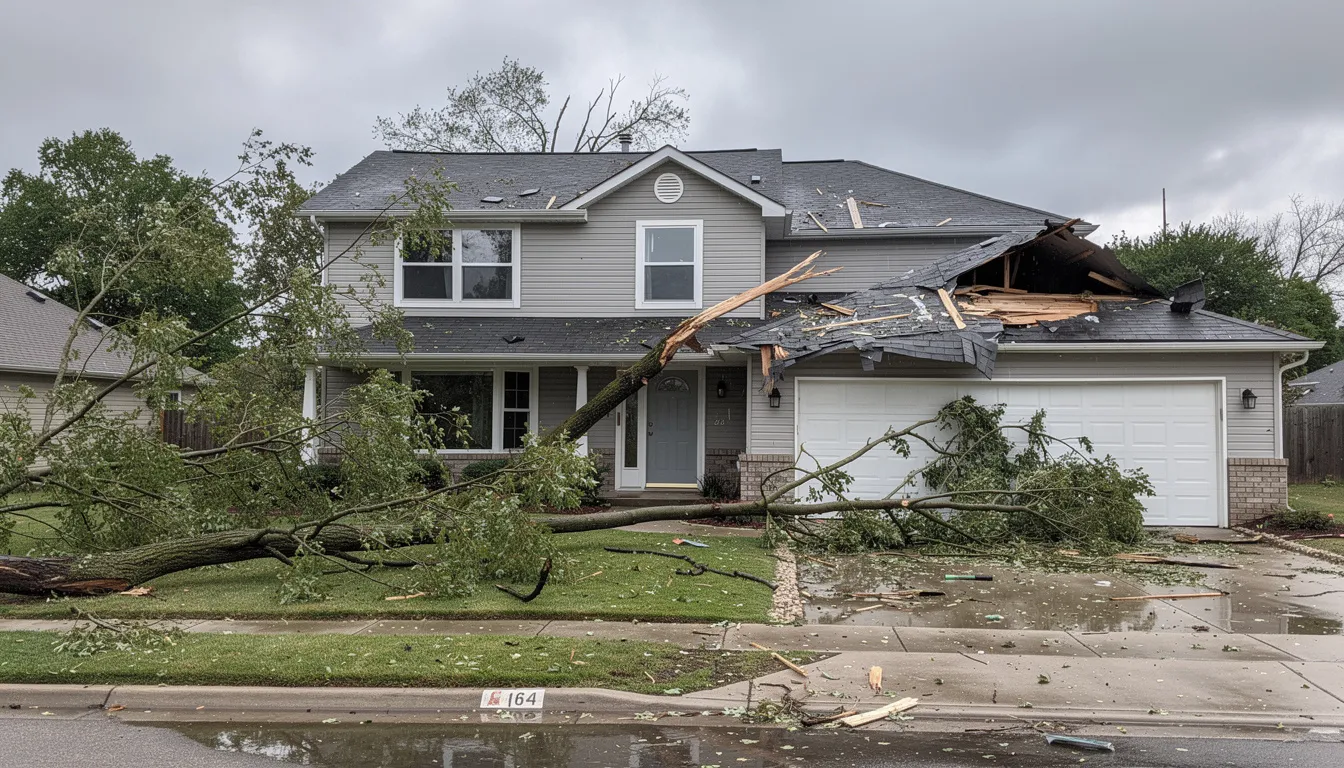
Myth #1: “Home Insurance Is a Waste of Money If I Never Make a Claim”
Picture this: a 2023 Midwestern hailstorm rolls through your neighborhood. In twenty minutes, your roof sustains $40,000 in damage. The siding needs replacement. Your car in the driveway has dents on every panel. If you’ve been paying roughly $1,500 per year in homeowners insurance premiums, that single storm just justified over 25 years of payments.
Homeowners insurance isn’t designed to be a savings account where you get your money back. It’s financial protection against rare but catastrophic losses—the kind that can wipe out your savings or put your entire home at risk. A kitchen fire, a major liability lawsuit from an injured guest, or a burst pipe flooding your finished basement can easily cost six figures to resolve.
Here’s another reality check: most mortgage lenders won’t fund your home loan without proof of coverage. Why? Because your house is likely your largest asset, often worth $300,000 or more. The lender needs protection, and frankly, so do you.
When evaluating whether your policy is “worth it,” focus on coverage quality, appropriate limits, and claims service—not just finding the cheapest premium. The lowest-cost policy often becomes the most expensive after a claim denial.
Myth #2: “I Should Insure My Home for Its Market Price or What I Paid”
This is one of the most expensive misconceptions in home insurance. Your dwelling coverage should be based on replacement cost—what it would actually cost to rebuild your home from the ground up—not the market value or purchase price.
Why? Because market value includes land (which can’t burn down) and location premiums (a desirable neighborhood doesn’t affect lumber prices). What matters for insurance is construction costs: materials, labor, and local building codes.
Consider this example: You purchased your home for $350,000 in 2018. Today, between supply chain disruptions, labor shortages, and building material inflation, that same home might cost $475,000 or more to rebuild. If you insured it for the purchase price—or worse, let your coverage drift without updates—you could face a massive shortfall after a total loss.
Here’s where it gets worse. If your dwelling coverage is less than 80% of your home’s actual replacement cost value, many policies trigger coinsurance penalties. That means even on a partial loss, your insurer might only pay a fraction of the repair costs. A $100,000 kitchen fire on an underinsured home could leave you responsible for $30,000 or more out of pocket.
Most insurers run replacement cost estimators using your home’s square footage, construction type, and local construction costs. Review these estimates every one to two years—especially after significant inflation or local building booms—to make sure your limits still make sense.
Myth #3: “All My Stuff Is Covered, and I’ll Get Brand-New Replacements”
Understanding what your policy actually covers requires separating two things: dwelling coverage (the structure) and personal property coverage (your belongings inside). Both have limits. Both have exclusions. And both can surprise you at claim time.
Actual Cash Value vs. Replacement Cost Coverage
Not all policies are created equal when it comes to paying for your personal belongings. The difference between Actual Cash Value (ACV) and replacement cost coverage can mean thousands of dollars.
With ACV, the insurer pays what your item is worth today, after depreciation. That 10-year-old TV you bought for $1,200? Under ACV, you might receive $150—the depreciated value of a decade-old television. Good luck buying a comparable replacement with that.
Replacement cost coverage pays what it actually costs to buy a similar new item. The premium is typically 10–20% higher, but the payout difference at claim time is dramatic.
Sub-Limits Can Leave You Short
Even with generous personal property limits, most policies cap certain categories:
| Category | Typical Sub-Limit |
|---|---|
| Jewelry & Watches | $1,500–$2,500 |
| Silverware | $2,500 |
| Firearms | $2,500 |
| Cash | $200 |
| Art & Collectibles | $2,500 |
| Electronics (per item) | Varies by policy |
These limits apply regardless of your total personal property coverage. If you have a $5,000 watch and a $10,000 engagement ring, you’ll hit that $1,500–$2,500 jewelry cap immediately after a theft.
What to do: Consider adding replacement cost coverage if you have ACV, and schedule valuable items separately for full protection.
Home Inventory: Your Claim Lifeline
One of the simplest ways to speed up claims and prove ownership is maintaining a dated home inventory. Walk through your home with your smartphone, recording video of each room—open closets, drawers, and cabinets. Note brand names and model numbers for valuable items. Store the footage in the cloud where a fire can’t destroy it.
This documentation can mean the difference between a fully paid claim and a frustrating dispute over what you actually owned.
High-Value Items and Collections: Why Your Policy May Not Be Enough
If you own an $8,000 diamond ring, a $15,000 art piece, or a collection of rare coins, your standard homeowners policy almost certainly doesn’t provide enough coverage.
The solution is “scheduling” these items. You provide appraisals for each piece, and the insurer agrees to cover them for a specific amount—often with no deductible and all-risk protection (including accidental loss, not just theft or fire).
Here’s a scenario: A thief breaks into your home and steals jewelry worth $20,000. Without scheduling, you receive only $2,500 (the sub-limit) minus your deductible. With properly scheduled personal items, you receive the full appraised value.
Get professional appraisals every few years, especially for items affected by market fluctuations like gold, gemstones, or collectibles. The current market for these items changes, and your scheduled values should reflect reality.

Myth #4: “Standard Home Insurance Covers Floods and All Types of Water Damage”
Water damage is one of the most misunderstood areas of homeowners insurance. The critical distinction: where did the water come from?
Your standard homeowners policy generally covers:
- Burst pipes (if sudden and accidental)
- Appliance failures (washing machine hose ruptures, water heater leaks)
- Rain entering through storm-damaged roofs (if the roof damage itself is from a covered peril)
Your standard policy almost never covers:
- Flood damage from natural disasters (rising water from rivers, storm surge, heavy rain pooling)
- Sewer backup or sump pump failure (unless you add an endorsement)
- Gradual leaks or seepage from poor maintenance
- Water entering through foundations
According to FEMA data, floods and earthquakes account for over 90% of natural disaster damages in the U.S.—and standard homeowners insurance excludes both. The average flood claim through the National Flood Insurance Program exceeds $40,000 per household.
For flood coverage, you’ll need a separate flood insurance policy through the National Flood Insurance Program or private insurers. These policies have waiting periods (typically 30 days), so you can’t buy one when a hurricane is already forecast.
Talk to your insurance agent about endorsements for sewer and drain backup ($50–$100 per year for $5,000–$25,000 coverage) and sump pump failure. These add-ons address specific water risks that your base policy ignores.
“I Don’t Live in a Flood Zone, So I Don’t Need Flood Insurance”
This might be the most dangerous variation of this myth. FEMA flood zone maps identify high-risk areas, but they don’t predict every flood.
Consider this scenario: A 10-inch rain event dumps water on your neighborhood in 24 hours. Storm drains overflow. Water backs up through streets and into homes. Your property—technically in a “low-risk” zone—now has 18 inches of water in the basement.
Your homeowners insurance? It won’t pay a dime for flood damage. That designation as “low risk” doesn’t mean “no risk.”
The encouraging news: flood policies in lower-risk zones are often relatively affordable—sometimes $400–$600 per year compared to $1,000+ in high-risk zones. That’s cheap insurance against a five-figure loss.
Check FEMA maps and your local flood history, but don’t rely on them alone. If your area has experienced flash flooding, heavy rain events, or drainage problems, a separate policy may be worth the peace of mind.

Myth #5: “My Policy Covers Any Damage to My Home, Even from Wear and Tear or Neglect”
Insurance is built around a fundamental principle: coverage for sudden, accidental events—not gradual deterioration or predictable decay.
Your policy will cover a tree falling on your roof during a storm. It won’t cover shingles that failed after 25 years of sun exposure. The difference is between an accident and a maintenance issue.
Examples of what’s typically NOT covered:
- Roof leaks that developed slowly over months or years
- Rotted deck boards from moisture exposure
- Corroded or rusted pipes that finally fail
- Foundation cracks from settling
- Mold resulting from ongoing humidity problems
- Termite, carpenter ant, or rodent damage
When you file a claim for water damage, the adjuster’s first question is often: “Was this sudden, or has it been happening for a while?” Evidence of gradual damage—water stains, warping, discoloration—can trigger a denial.
Prevention is your best protection here. Annual roof inspections, spring and fall gutter cleaning, regular HVAC servicing, and prompt attention to small problems all prevent the uncovered damage that maintenance issues create.
Mold, Pests, and “Hidden” Problems
Mold and pest damage are among the most commonly misunderstood exclusions. Many homeowners assume that any mold problem should be covered—after all, it’s damaging the home.
But insurers treat most mold growth as a homeowner maintenance responsibility. Why? Because mold typically results from conditions that develop over time: high humidity, poor ventilation, slow leaks, or deferred repairs. These are preventable with routine inspections.
Similarly, termite damage isn’t covered because it develops gradually and can be detected with regular pest inspections. A surprise termite swarm doesn’t make the infestation sudden—those colonies took years to establish.
Warning signs to watch for:
- Musty smells, especially in basements or bathrooms
- Soft spots in floors or walls
- Mud tubes on foundations (termite sign)
- Peeling paint or bubbling wallpaper near water sources
When you spot these signs early, repairs are often minor. Wait too long, and you’re facing uncovered reconstruction costs.
Document your maintenance efforts—save receipts for pest inspections, HVAC servicing, and repairs. In borderline claim situations, proof of consistent upkeep can support your case.
Myth #6: “If Someone Is Hurt on My Property, All Medical Costs Are Automatically Covered”
Liability coverage is essential, but it doesn’t work the way many homeowners assume.
Your homeowners policy typically includes two types of injury-related coverage:
| Coverage Type | What It Covers | Typical Limits |
|---|---|---|
| Medical Payments to Others | Guest injuries regardless of fault | $1,000–$5,000 per person |
| Personal Liability | Lawsuits from third-party injuries | $100,000–$300,000+ |
Important distinction: Neither coverage pays for injuries to you or family members living in your home. Those are handled by your health insurance, not home insurance.
Here’s a practical example: A guest trips on your stairs and breaks an arm. Medical payments coverage might pay $3,000–$5,000 toward immediate bills, no questions asked. But if that guest’s injury is severe—requiring surgery, rehabilitation, and ongoing treatment—medical payments won’t come close. That’s when liability coverage kicks in, covering lawsuit costs and settlements up to your policy limit.
The problem? Standard liability limits often start at just $100,000. A serious injury lawsuit can easily exceed that, putting your savings, investments, and future earnings at risk.
Recommendation: Review your liability limits and consider increasing to $300,000 or $500,000. If you have significant assets to protect, an umbrella policy ($1 million or more in coverage for $150–$300 per year) provides crucial additional protection.
Home Businesses and Visiting Clients
Standard homeowners liability often excludes incidents connected to home-based business activities. This catches many homeowners off guard.
Consider this scenario: You run a small home salon or tax preparation office. A client slips on your icy front walkway while arriving for an appointment. Because this injury occurred in connection with your business, your regular homeowners policy may deny the claim entirely.
The exclusion extends beyond client injuries. Business equipment stored at home—inventory for online sales, professional cameras, specialized tools—often has very limited coverage under a standard homeowners policy.
If you earn money from home through childcare, consulting, beauty services, online sales with inventory, or any other activity that brings clients to your property, ask your insurance agent about:
- Business endorsements to your homeowners policy
- Separate business owner’s policies (BOP)
- In-home business insurance riders
A small additional premium can prevent a massive coverage gap.
Myth #7: “Older Homes Are Cheaper to Insure Than Newer Ones”
Many homeowners assume that a smaller, older home should cost less to insure than a modern McMansion. In practice, the opposite is often true.
Older homes present unique insurance challenges:
Higher repair and replacement costs: Plaster walls, custom woodwork, stained glass windows, slate roofs, and non-standard architectural features cost significantly more to repair or replicate than modern materials. A contractor can replace drywall easily; matching 100-year-old plaster requires specialized craftsmen.
Outdated systems: Knob-and-tube wiring, galvanized plumbing, and old electrical panels increase fire and water damage risks. Some insurers won’t cover homes with these systems at all; others require upgrades before issuing a policy.
Building code compliance: If your 1920s home suffers major damage, rebuilding to current codes may cost far more than repairing the original structure.
Contrast this with newer homes built to modern codes: updated wiring, fire-resistant materials, better wind and seismic design, and standardized construction methods. These factors can actually lower premiums.
If you own an older home, ask your agent:
- Are any system upgrades required for coverage?
- Do you have “replacement cost” or “functional replacement” coverage? (The latter pays for modern equivalents rather than exact replication)
- Are discounts available for updating electrical, plumbing, or roofing?
Understanding these factors helps you avoid surprise higher premiums or coverage restrictions.
Myth #8: “Every Claim Will Make My Premium Skyrocket, So I Should Never File One”
Some homeowners avoid filing legitimate claims out of fear, paying $15,000 out of pocket for storm damage to “protect” their rates. Others file every small claim, not realizing the cumulative effect.
The truth lies in the middle.
Not every claim leads to a rate increase. Impact depends on:
- Claim type: Weather-related claims in disaster areas often affect all policyholders equally, not just those who file.
- Claim size: A $50,000 fire claim may not increase rates more than a $5,000 water damage claim.
- Claim frequency: One claim in five years rarely causes problems. Two or three claims within two years raises red flags.
- Insurer guidelines: Each company handles claims history differently.
Data suggests average premium surcharges of 20–40% following claims, but this varies significantly by insurer and claim type.
Practical approach: Get repair estimates before filing. If the repair cost is close to or below your deductible, paying out of pocket usually makes more sense. But don’t avoid filing a $40,000 claim because you’re worried about a $200 annual rate increase.
Smart Claim Strategy to Protect Your Record
When damage occurs, follow these steps to protect yourself:
- Document everything immediately. Take photos and videos of all damage before any cleanup or repairs. Capture wide shots and close-ups.
- Prevent further damage. Tarp a damaged roof, board up broken windows, and shut off water if pipes burst. Your policy requires you to mitigate further loss.
- Get repair estimates. Know the actual cost before deciding whether to file.
- Call your agent to discuss options. Ask specifically: “Will this conversation be logged as a claim inquiry?” In some states and with some insurers, informal conversations don’t affect your record.
- Track your claims history. Keep records of all claims filed (dates, amounts, types) since insurers typically review several years of loss history when pricing policies.
For clearly covered, large losses—major fires, severe storm damage, significant theft—report promptly. That’s exactly what the policy is for. The goal is avoiding insurance for nuisance-sized repairs while using it fully for catastrophic protection.

Myth #9: “Lowering My Coverage Is the Only Way to Lower My Premium”
When premiums rise, the temptation to reduce coverage limits is understandable. But cutting dwelling coverage from $400,000 to $300,000 to save $300 per year could leave you $100,000 short after a major fire.
There are smarter ways to save money on premiums without sacrificing protection:
Higher deductibles: Moving from a $500 to a $1,500 deductible might save $200–$400 annually. You’re accepting more out-of-pocket risk for smaller claims in exchange for lower premiums. Just make sure you have the deductible amount available in savings.
Bundle policies: Combining home and auto insurance with the same carrier typically yields 10–25% discounts on both policies.
Home improvements: New roofs, updated electrical panels, impact-resistant windows, and monitored security systems can all reduce premiums.
Maintain good credit: In most states, credit-based insurance scores affect premiums. Improving credit can lower costs.
Review annually: Major changes—renovations, additions, finished basements—can both increase needed coverage and sometimes qualify for modernization discounts.
| Strategy | Typical Savings | Trade-Off |
|---|---|---|
| Raise deductible $500 → $1,500 | $200–$400/year | Higher out-of-pocket at claim time |
| Bundle home + auto | 10–25% | Less flexibility to switch carriers |
| Install security system | 5–15% | Monitoring fees ($20–$50/month) |
| New roof | 5–20% | Upfront renovation cost |
Priority principle: Maintain adequate dwelling coverage and liability limits even when cutting costs. These protect against the largest potential losses. Savings should come from deductible choices and discounts, not reduced protection.
Myth #10: “Once I Buy a Policy at Closing, I Never Need to Look at It Again”
Your life changes. Your home changes. Your coverage needs to keep up.
Events that should trigger a policy review:
- Adding a deck, pool, or detached structure
- Finishing a basement or attic
- Major kitchen or bathroom renovations
- Starting a home-based business
- Getting married or having children
- Acquiring expensive jewelry, art, or collections
- Adding a dog (especially certain breeds)
Beyond personal changes, external factors evolve too. Construction costs have risen roughly 7% annually in recent years. Building codes change. New risks emerge in your area. A homeowners policy written in 2016 almost certainly doesn’t fit your home’s 2026 reality.
Recommendation: Schedule an annual or biannual coverage review, ideally around your policy renewal date. Prepare with a simple checklist:
- [ ] Any purchases over $1,000?
- [ ] Any remodeling or additions completed?
- [ ] Changes in household members?
- [ ] New pets or business activities?
- [ ] Any major life events?
During reviews, ask direct questions:
- “What isn’t covered by this policy?”
- “What single event could cost me the most?”
- “Are my limits enough coverage for today’s rebuild costs?”
- “Which endorsements should I consider adding?”
Your insurance agent should welcome these conversations. If they don’t, consider whether you have the right coverage—or the right agent.
Frequently Asked Questions About Costly Home Insurance Myths
Q1: How often should I update the amount of insurance on my home?
Review your dwelling limits at least once per year and after any major renovation, addition, or local construction cost spike. If contractors in your area are quoting prices 20–30% higher than a few years ago, your coverage may already be outdated. Contact your insurance agent if you hear about significant material or labor price increases—lumber and roofing costs have been particularly volatile recently.
Q2: Does home insurance cover my belongings when I’m traveling?
Yes, most policies offer off-premises coverage for personal property worldwide. However, this coverage is typically limited to around 10% of your total personal property limit. The same sub-limits apply—that $2,500 jewelry cap still applies whether the theft occurs at home or in a hotel room. For extended travel or high-value items, consider additional coverage options or travel insurance.
Q3: Are short-term rentals, like listing a room or my whole house on a rental platform, covered under standard home insurance?
Generally, no. Most standard homeowners policies exclude or severely limit coverage when your home is used as a short-term rental business. Injuries to guests, property damage during rentals, and your own liability may not be covered. You’ll likely need a dedicated short-term rental endorsement, a landlord policy, or specialized vacation rental insurance. Some platforms offer host protection, but this shouldn’t replace proper insurance coverage.
Q4: If I finish my basement or add a big renovation, do I automatically get more coverage?
No—coverage does not automatically adjust when you improve your home. You must notify your insurer so dwelling limits can be updated to reflect the increased value. For finished basements specifically, you may also want water backup endorsements, since standard policies often exclude sewer and sump pump failures that commonly affect below-grade spaces.
Q5: How can I quickly find out what isn’t covered by my policy?
Start by reading the “Exclusions” and “Limitations” sections of your declarations page and policy documents—these list what the policy explicitly doesn’t cover. Then schedule a call with your insurance agent to walk through the main uncovered events: flood, earthquake, wear and tear, sewer backup, and certain water damage types. Ask which add-ons are available to close the most important gaps for your situation. A 30-minute conversation can prevent thousands in uncovered losses.